


Most development problems are not technical; they are coordination problems. A front-end team that does not understand the API constraints. A back-end team that did not anticipate the UI state requirements. We eliminate those seams entirely by owning every layer of your product from the first design decision to the final deployment.
Request Your Free Full-Stack Project Assessment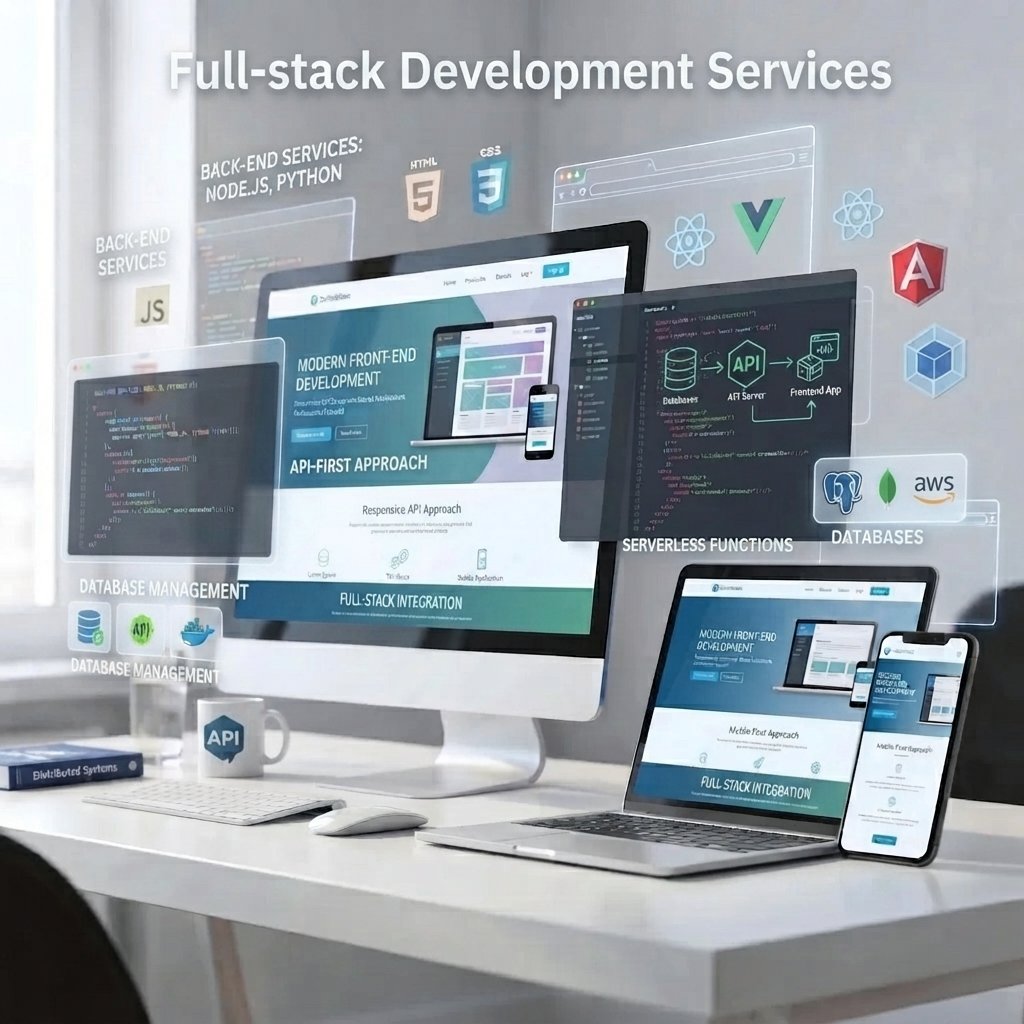

At Sarash Tech, we build complete products end to end, making architecture decisions that account for the full system, shipping features that work correctly across every layer from day one, and solving problems that cross boundaries without the delay of inter-team escalation. One team, one codebase, one product that behaves the way it was designed to.
When one team owns every layer, architecture decisions reflect the actual constraints and requirements of the entire product, not the locally optimal choice for a single layer that creates problems for every other layer it touches. Whole-system thinking produces products that hold together under real conditions.
Step 01
The most expensive bugs in any project are the ones discovered at integration when two separately developed layers meet for the first time, and the assumptions baked into each side turn out to be incompatible. A full-stack team eliminates that category of problem entirely. Front end and back end are built with continuous, real integration from the start, not stitched together under deadline pressure at the end of a development cycle.
Step 02
Every new vendor or specialist team starts from zero understanding of your product. Every handoff loses context. A full-stack team that has owned your product for months or years carries the accumulated institutional knowledge of every architectural decision, every edge case discovered in production, and every business requirement that shaped the system, making them dramatically more effective at every subsequent feature, fix, and optimization than a team encountering the codebase for the first time.
Step 03
Full-stack development done well requires more discipline at the discovery and architecture phase than specialized development, because the decisions made before a line of code is written determine whether the system holds together coherently or accumulates debt at every layer simultaneously.
We begin with a thorough discovery process that maps the complete product user journeys, data models, integration requirements, performance constraints, security obligations, and growth trajectory before making any technology or architecture decisions. The output is a full-system architecture document that defines the front-end component strategy, back-end service design, database schema, API contract structure, infrastructure topology, and deployment pipeline, agreed and understood by every member of the team before development begins.
User experience design and system architecture are developed in parallel rather than in sequence because the best UI decisions are informed by what the system can deliver efficiently, and the best system decisions are informed by what the UI actually needs to do. Wireframes, data models, and API contracts are iterated together so the design that goes into development is both desirable for users and buildable without back-end contortions that compromise performance or correctness.
Full-stack development at Sarash Tech follows consistent engineering standards across every layer of the stack — the same code review discipline, the same test coverage requirements, the same documentation expectations, and the same deployment quality gates whether we are working on a React component, a database migration, or an infrastructure configuration change. Shared standards are what make a full-stack codebase something a team can actually maintain, extend, and hand back to an internal team with confidence.
After launch, a full-stack team’s advantage compounds because when something goes wrong in production, the same team that built every layer investigates every layer simultaneously. No inter-team ticket escalation, no finger-pointing between front-end and back-end owners, no delay while a specialist is on-boarded to an unfamiliar part of the system. We identify the root cause, implement the fix across whatever layers it touches, and ship the resolution faster than any fragmented team structure allows.
Sarash Tech delivers complete full-stack development unified architecture, consistent engineering standards, and a single accountable team that understands your product as a whole, not as a collection of disconnected specialities.
Calculate Project CostINDUSTRIES
Complete product ownership requires a deep understanding of the specific compliance obligations, user behavior patterns, performance standards, and integration ecosystems of the industry your product operates in. We bring that understanding to every full-stack engagement.

SaaS products live or die on the coherence of the complete user experience, the moment onboarding friction, billing edge cases, or dashboard performance breaks down, churn follows. We build SaaS products end to end with a unified team that understands how the subscription data model drives the UI permission logic, how the usage metering system feeds the billing API, and how the front-end loading states need to reflect the actual asynchronous behavior of the back-end data pipeline because those connections are where SaaS products break, and a team that owns all of them can prevent that from happening rather than diagnosing it after users have already left.
Every seam between a front-end team and a back-end team is a place where assumptions go wrong, bugs hide, and accountability disappears. The products that earn user loyalty and scale reliably are the ones built by teams who own the complete picture. Sarash Tech delivers that ownership one team, every layer, one product you can trust.
Start Building a Front End That PerformsWe needed a custom booking system connected to a database, not just a template. Sarash Tech built the front end and back end so everything talks to each other properly
They built our internal dashboard from scratch, handling both the API and the interface. It's saved our team hours of manual data entry every week.
Our app needed user accounts, a database, and payment processing all working together. Sarash Tech handled the full stack without passing us between different developers
They rebuilt our backend to handle more traffic without breaking things on the front end. The whole system feels more stable now.





Sarash Tech’s full-stack capability is not a combination of separate front-end and back-end practices it is a unified engineering discipline built around the understanding that the quality of a digital product is determined by how well its layers work together, not how good each layer is in isolation. Every full-stack engagement is led by engineers who understand the complete system and make decisions at every layer with that full understanding in view.
From React and Next.js front ends consuming Node.js and Python APIs, backed by PostgreSQL and Redis data layers, deployed on AWS or Google Cloud infrastructure with automated CI/CD pipelines to Vue.js and Nuxt.js applications on Laravel back ends with MongoDB data stores deployed on containerized Kubernetes infrastructure we build the complete combination that serves your product’s actual requirements, not the stack that happens to be our default.
End-to-end JavaScript development across the complete stack React or Angular on the front end, Node.js with Express on the back end, and MongoDB for the data layer enabling shared language, shared tooling, and shared engineering patterns across every layer of the product. We architect MERN and MEAN stacks with the same discipline we apply to any production system explicit state management, comprehensive API contracts, proper authentication flows, and test coverage across every layer.
Full-stack development on the Next.js platform combines server-side rendering, static generation, API routes, and client-side React in a unified application framework that eliminates the operational separation between front-end and back-end deployment. We architect Next.js full-stack applications with deliberate page-level rendering strategy decisions, efficient data fetching patterns using React Query or SWR, and back-end API routes structured with the same discipline as standalone Node.js services. Next.js full-stack architecture is particularly effective for content-driven products, marketing platforms, and SaaS applications where SEO, performance, and development velocity need to coexist without the operational overhead of maintaining separate front-end and back-end deployment pipelines.
Full-stack development combining React.js front ends with Django REST Framework back ends pairing React’s component-driven UI architecture with Django’s mature ORM, authentication system, and ecosystem depth in data processing and business logic. We architect React and Django full-stack applications with a clean API boundary between the front-end client and the Django back end, enabling the two layers to evolve independently while sharing a consistent data contract.
Full-stack development combining Vue.js or Nuxt.js front ends with Laravel back ends a combination that offers high development velocity, strong conventions on both sides of the stack, and an ecosystem of first-party packages that handle authentication, queuing, real-time events, and file storage without requiring custom implementation. We architect Vue and Laravel full-stack applications with the clean separation of concerns that makes them maintainable as they grow Vuex or Pinia state management on the front end, Laravel service classes and repository patterns on the back end, and API resource serialization that keeps the data contract explicit and evolvable.
Full-stack database architecture that serves the query patterns of the application across every layer from the ORM queries the back-end service layer executes to the caching strategy that keeps front-end data loads fast to the analytics queries that power reporting dashboards. We design schemas and data access patterns with the full application in view: normalization and indexing decisions reflect the actual queries the back end runs in production, caching layers using Redis reduce round trips for data the front end requests repeatedly, and read replicas or materialized views handle the heavy analytical queries without degrading the transactional database performance that real-time features depend on.
Full-stack authentication architecture that enforces identity and access control consistently from the browser to the database. We implement complete authentication systems using OAuth 2.0, OpenID Connect, or session-based authentication depending on the product’s requirements — with JWT handling on the front end, token validation and permission enforcement in every back-end API route, and row-level security policies in the database that guarantee data isolation regardless of application-layer behavior. Single sign-on integration, multi-factor authentication, and social login flows are implemented with the same consistency across every surface of the product. Full-stack ownership of authentication means there are no gaps between the UI permissions a user sees and the data the back end actually protects.
Full-stack real-time feature development — from the WebSocket client implementation on the front end through the server-side event broadcasting infrastructure to the database change detection or message queue triggers that generate the events. We build real-time features including live notifications, collaborative editing, chat systems, activity feeds, and dashboard data streaming with the full-stack context needed to make performance and reliability decisions that account for every layer: front-end reconnection handling, back-end connection management under concurrent load, and the database query or message broker architecture that feeds events into the real-time system without becoming a bottleneck.
End-to-end deployment infrastructure that treats the full-stack application as a single, coherent system to deploy, monitor, and operate not as a front-end and a back-end that happen to be deployed around the same time. We build CI/CD pipelines that run the complete test suite across every layer before any deployment proceeds, with staging environments that mirror production at every layer simultaneously. Containerized deployment with Docker and Kubernetes or managed container services ensures front-end and back-end versions are deployed in coordinated releases that maintain API compatibility. Centralized logging, distributed tracing across both front-end and back-end events, and unified alerting give the complete operational visibility that full-stack systems require to be diagnosed and resolved quickly when something goes wrong in production.

Whether you're planning a new website, mobile app, or digital marketing strategy, Sarash Tech is here to help. Fill out the form and let's start the conversation.
Call us directly
+977-9765355161
Email us
info@sarashtech.com
Chat with us
Open Chatbox