Discover why SEO is essential for every U.S. business in 2026. Increase visibility, attract qualified leads, outrank competitors, and grow revenue organically.
Running a business used to come down to a few reliable things. A good location helped. Regulars kept the doors open. A listing in the yellow pages handled the rest. For a long stretch of time, that combination was genuinely enough.
That era ended, and it is not coming back.
Before a customer walks through any door today, they have already searched online. Before they pick up the phone, they have already read reviews. Before they sign anything, they have already reviewed three or four competitors’ websites and formed an opinion. This is true across industries, across age groups, and across purchase sizes. A person buying a ten-dollar product and a person approving a fifty-thousand-dollar contract both start the same way now. They open a search engine.
Google processes more than 8.5 billion searches every single day. That number has been climbing every year, and there is no sign of it slowing. Mobile devices have made searching a reflex rather than a deliberate action. People search from parking lots, from waiting rooms, from sofas at eleven at night. The search bar has become the default answer to almost every commercial question a person has.
Each of those searches is a moment when a business either shows up or does not. Showing up consistently, for the right searches, in the right positions, is what SEO delivers. In 2026, no other tool accomplishes that as reliably or as cost-effectively over time.
The word optimization puts a lot of people off. It sounds like something that belongs in a server room, not in a conversation about business growth. That misunderstanding has caused many business owners to either hand SEO off without really understanding what they are paying for or to ignore it entirely on the assumption that it is too technical to be worth their attention.
Neither response serves the business well.
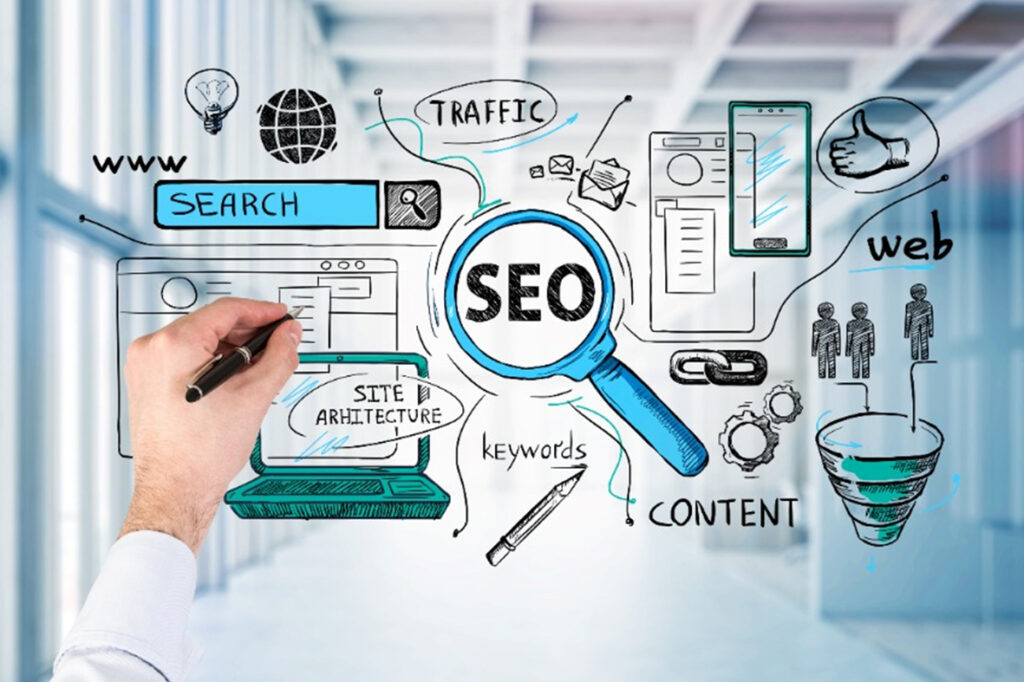
SEO in 2026 is fundamentally about being findable, credible, and useful online. That sounds simple because at its core, it actually is. Search engines want to show people the most relevant, trustworthy results for whatever they searched for. Businesses that demonstrate relevance and trustworthiness consistently rank. Businesses that do not, do not.
Demonstrating those qualities online involves several connected things. Content needs to directly address what real customers are searching for, written in a way that actually helps rather than just ticking keyword boxes. The website needs to work properly on every device without making visitors wait. The business needs to earn recognition from other credible sources online. Reviews need to exist and be genuine. The overall picture that the website presents needs to match what the business actually does and who it actually serves.
Google evaluates all of this under a framework it calls E-E-A-T, which stands for Experience, Expertise, Authoritativeness, and Trustworthiness. Businesses that score well across these dimensions rank. The formula rewards quality over shortcuts every time. That makes SEO one of the few marketing channels where being genuinely good at what a business does translates directly into better results.
Keyword data is market research disguised as a technical metric. When a potential customer types something into a search engine, they are stating a need, a problem, or an intention with remarkable clarity. Aggregated across millions of searches, that data tells businesses exactly what their target customers want, what language they use to describe it, what questions they have before committing, and what concerns they carry throughout the process.
Search behavior has become more specific over time, not less. The era of people typing one or two word queries is largely over. Today, a person looking for a dentist does not search “dentist.” That person searches for “affordable dentist accepting new patients near me” or “dentist open Saturday in my area.” The specificity reveals intent. It reveals a person who knows what they want and is close to acting on it.
This matters for business because intent-driven traffic converts differently than passive advertising exposure. Someone who clicked an ad did not ask to see it. Someone who found a business by searching for exactly what that business offers arrived with purpose. The mindset of that visitor when they land on a page is fundamentally different and the conversion rates reflect that difference clearly.
Understanding search behavior also helps businesses identify gaps in their current content and opportunities their competitors have missed. A keyword that gets consistent searches but has few strong results competing for it represents traffic that a well-written, well-optimized page can capture quickly. Businesses that pay attention to these gaps and move on them gain advantages that compound month after month.
Something quietly happens in a person’s mind when they see a business appearing near the top of search results without a paid label next to it. They trust it more. The assumption is that earning that position required something genuine. Whether or not the person could articulate that logic, the effect on their perception is real and measurable.
This matters enormously in a moment when consumer scepticism toward advertising has never been higher. People have been exposed to so much promotional messaging for so long that they have developed strong instincts for filtering it out. Ads are mentally catalogued as interested parties making claims on their own behalf. Organic rankings carry a different weight because no one is paying directly to appear there.
A business that ranks organically for terms related to what it sells is perceived as credible before a single word on its website has been read. That credibility head start translates into lower bounce rates, longer time spent on pages, and higher conversion rates compared to paid traffic arriving with the same intent.
The compounding nature of this credibility is what makes SEO such a powerful long-term investment. A potential customer who encounters a business in search results repeatedly across multiple searches over several weeks or months develops a familiarity with that brand before any transaction has occurred. When that person is finally ready to buy, the business already feels known. Known quantities get chosen over unfamiliar ones. This effect cannot be manufactured through advertising alone.
Paid advertising works. For many businesses, it works extremely well in specific situations and for specific goals. The issue is not whether it is effective. The issue is the financial structure underneath it.
Every pay-per-click campaign, every social media ad, every sponsored placement operates on the same model. Money buys attention for a defined period. When the money stops, the attention stops. Immediately and completely. Nothing is left behind. No asset, no residual value, no traffic continuing to arrive next month because of work done this month.
SEO operates differently at a structural level. The content, rankings, and authority built through organic search accumulate over time. A page that earns a strong position for a valuable keyword continues generating traffic and leads long after the work that produced it was completed. As more pages rank for more terms, the cumulative traffic grows without requiring proportional increases in spending.
The cost to acquire a customer through organic search tends to fall over time as authority builds and rankings expand. The cost to acquire a customer through paid advertising tends to rise as competition increases and auction prices climb. These two cost curves moving in opposite directions represent a genuine long-term financial advantage for businesses that take SEO seriously.
Starting an SEO program requires real investment. Writing quality content takes skill and time. Technical work requires expertise. Building authority is a sustained effort. But the financial model rewards patience in a way that advertising fundamentally cannot because the assets created do not expire.
Ask the owner of a successful local business in 2026 where most of their new customers come from and a significant portion will mention Google. Not because they ran a complicated campaign. Because they showed up when someone nearby was looking for what they offered.
The Google local pack, those three business listings that appear on a map at the top of location-specific searches, drives a volume of calls, visits, and bookings that surprises many business owners when they first start paying attention to where customers are actually coming from. The person conducting that search is not browsing out of curiosity. That person has a specific need and the clear intention to do something about it today.
Appearing in the local pack does not require a large marketing budget. It requires consistency and attention across a focused set of actions. A Google Business Profile must be fully completed and kept current. Hours, photos, service descriptions, and contact information need to be accurate and detailed. The business name, address, and phone number must match exactly across every online directory, review site, and listing where the business appears. Any inconsistency creates doubt in both the algorithm and the consumer.
Reviews are the factor that most local businesses underestimate until they look at what separates the businesses appearing in the local pack from the ones that do not. Volume matters. Recency matters. A business with forty recent reviews outperforms a business with a hundred old ones. Building a consistent, natural flow of genuine customer reviews is one of the highest-return habits any local business can develop.
The businesses not yet treating local SEO as a genuine revenue priority are leaving consistent, compounding income on the table every single month.
Every few years, a new technology arrives and someone declares that SEO is finally finished. AI search has generated the loudest version of this argument yet. The logic goes that if AI systems answer questions directly inside search results, nobody will click through to websites anymore, making rankings irrelevant.
This misunderstands how AI search actually works.
Google’s AI Overviews pull content from websites. Bing’s Copilot summaries pull content from websites. Perplexity cites websites directly in its responses. Every AI-generated answer in a search context is built on top of content that lives somewhere on the internet. The sources chosen are the ones these systems consider authoritative, well-structured, and genuinely helpful. These qualities are built through SEO.
Being cited inside an AI Overview is not a consolation prize compared to a traditional organic ranking. It is a better outcome because the business’s information appears before the user clicks anything, at the very top of the search experience, presented as a trusted source. Capturing this position requires the same things that traditional SEO has always required: clear content that directly answers specific questions, proper technical structure, and genuine authority earned over time.
The businesses that treated SEO as optional before AI search arrived are now further behind than ever. The businesses that invested consistently in organic search foundations are positioned to capture AI search real estate alongside traditional rankings. The channel has evolved. The fundamentals driving success within it have not changed at all.
One benefit of investing seriously in SEO that rarely gets discussed is how much it improves everything else a business does in marketing. The two disciplines are rarely discussed together but the connection between them is significant and practical.
Content produced for organic search purposes gives a business material to work with across social media, email campaigns, sales conversations, and customer onboarding. A genuinely useful guide written to capture organic traffic does not stop being useful once it ranks. That same content can anchor a month of social posts, become a sales leave-behind, inform an email newsletter, and help new customers understand what they purchased. One investment produces value across multiple channels simultaneously.
Keyword research conducted for SEO purposes is among the most useful market intelligence a business can gather. Understanding what specific words and phrases real customers use when searching for solutions, what questions surface repeatedly during research, and what concerns show up before a purchase decision reveals buyer psychology that shapes more effective messaging in advertising, in sales scripts, and in customer service. This intelligence does not stay siloed in the SEO team. It improves communication across the entire business.
Paid advertising campaigns become more efficient when organic coverage already exists for important terms. A business that ranks organically for high-intent keywords can focus paid budget on competitive terms where organic ranking takes longer to achieve. This combination produces better coverage at a lower overall cost than relying on paid advertising alone.
Technical improvements made for SEO, faster load times, cleaner navigation, better mobile performance, clearer page structure, benefit every visitor regardless of how they arrived. The investment in a better website for ranking purposes improves conversion rates for traffic from paid, social, email, and direct channels as well.
There is no invoice for missed opportunities. No monthly statement arrives showing how many people searched for a product, found a competitor ranking above the business, and bought from that competitor instead. The absence of this visibility makes ignoring SEO feel consequence-free. It is not.
Every relevant search that produces a competitor’s listing instead of a particular business represents a customer actively choosing to spend money elsewhere. Across a month, this amounts to meaningful lost revenue. Across a year, the compounded loss is often larger than the annual cost of a proper SEO program. Across several years, the gap between businesses that invested and those that did not becomes very difficult to close.
Beyond direct lost sales, neglecting SEO creates a growing structural problem. Businesses without an organic search presence must pay to attract every visitor they want. As advertising costs rise across platforms and channels, this dependency becomes an expanding liability. The businesses building SEO assets now are creating traffic that costs less over time. Their competitors without SEO are facing advertising costs that rise every year.
Consumer perception adds another layer to this cost. In 2026, a business that cannot be found for direct searches related to what it does raises quite a few doubts in potential customers, referral partners, and even prospective hires. Search visibility has become a baseline expectation for legitimacy. Its absence is noticed even when no one says so directly.
The businesses that make genuine progress with SEO are not always the ones with the largest budgets. They are the ones who start with the right priorities and follow through consistently. Getting the foundations right early makes everything that comes after more effective.
Technical health is the first priority because nothing else works without it. A website that loads slowly, breaks on mobile devices, or has errors preventing search engines from reading its content will not rank, regardless of content quality. Google Search Console is a free tool that surfaces the most critical technical problems clearly and should be reviewed by every business owner at least monthly.
Keyword research belongs in the second step because it informs every content decision that follows. The goal is to understand exactly what real customers search for when looking for what the business offers, with particular attention to phrases that reveal strong purchase intent. A local accounting firm does not just want to rank for “accountant.” That firm wants to rank for “small business accountant in city name” and “tax preparation for freelancers near me” and every other specific phrase that signals a ready buyer.
Content creation follows naturally from keyword research. Each core service or product needs a dedicated page that communicates clearly what is offered, who it serves, why this business is the right choice, and what the next step is. Supporting content addressing common questions and concerns builds topical authority and captures potential customers during the research phase before they have committed to a provider.
Local businesses must treat the Google Business Profile as a revenue asset requiring regular attention. A fully completed, consistently updated profile with genuine customer reviews is often the single highest-return SEO investment available to a brick-and-mortar or service-area business.
Measuring results from day one using Google Analytics alongside Search Console ensures that effort is directed toward what actually works. SEO without measurement is guesswork. With measurement, the strategy sharpens continuously.
Every significant shift in how consumers behave has separated the businesses that responded from those that waited for certainty before acting. The businesses that recognized early that online search was changing how purchasing decisions were made built advantages that took competitors years to close, and some never did.
SEO in 2026 represents exactly this kind of shift. The businesses treating organic search as a core business function now are compounding their advantages quietly while competitors spend more on advertising each year to maintain the same visibility. The businesses still treating SEO as optional are watching a gap form that becomes harder to bridge with every passing month.
Search is where buying decisions begin. For any business serious about growth in 2026, organic search visibility is not a marketing tactic. It is the ground that every other effort is built on.
Let our experts help you select and build the perfect solution tailored to your business goals.